

- Afrikaans
- Albanian
- Amharic
- Arabic
- Armenian
- Azerbaijani
- Basque
- Belarusian
- Bengali
- Bosnian
- Bulgarian
- Catalan
- Cebuano
- chinese_simplified
- chinese_traditional
- Corsican
- Croatian
- Czech
- Danish
- Dutch
- English
- Esperanto
- Estonian
- Finnish
- French
- Frisian
- Galician
- Georgian
- German
- Greek
- Gujarati
- haitian_creole
- hausa
- hawaiian
- Hebrew
- Hindi
- Miao
- Hungarian
- Icelandic
- igbo
- Indonesian
- irish
- Italian
- Japanese
- Javanese
- Kannada
- kazakh
- Khmer
- Rwandese
- Korean
- Kurdish
- Kyrgyz
- Lao
- Latin
- Latvian
- Lithuanian
- Luxembourgish
- Macedonian
- Malgashi
- Malay
- Malayalam
- Maltese
- Maori
- Marathi
- Mongolian
- Myanmar
- Nepali
- Norwegian
- Norwegian
- Occitan
- Pashto
- Persian
- Polish
- Portuguese
- Punjabi
- Romanian
- Russian
- Samoan
- scottish-gaelic
- Serbian
- Sesotho
- Shona
- Sindhi
- Sinhala
- Slovak
- Slovenian
- Somali
- Spanish
- Sundanese
- Swahili
- Swedish
- Tagalog
- Tajik
- Tamil
- Tatar
- Telugu
- Thai
- Turkish
- Turkmen
- Ukrainian
- Urdu
- Uighur
- Uzbek
- Vietnamese
- Welsh
- Bantu
- Yiddish
- Yoruba
- Zulu

The Role of Smoke House Technology in Modern Meat Processing Industry
The global meat processing industry continues to evolve through innovation, automation, and improved food safety standards. One of the most important traditional yet highly advanced processing methods is smoking, which enhances flavor, extends shelf life, and improves product preservation. Modern systems such as the umatshini wendlu yomsi, smokehouse industrial, izixhobo zendlu yomsi, kwaye izixhobo smokehouse have transformed this ancient preservation method into a highly controlled industrial process.
Today, smoking is no longer just a traditional craft—it is a precise, automated, and scalable production technique used by meat processing plants around the world. From sausages and bacon to smoked poultry and specialty meats, smokehouse technology plays a crucial role in delivering consistent quality products to global consumers.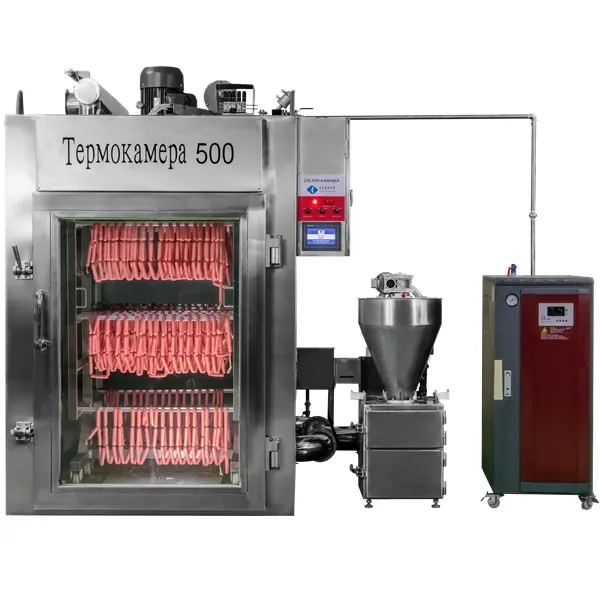
The Function and Importance of Smoke House Machines in Meat Processing
A umatshini wendlu yomsi is designed to expose meat products to controlled smoke, temperature, and humidity conditions. This process not only enhances flavor but also improves preservation by reducing moisture content and inhibiting bacterial growth. Modern smokehouse systems are highly advanced, allowing processors to control every aspect of the smoking cycle.
I izixhobo smokehouse used in industrial environments is built to handle large volumes of meat while maintaining consistent quality. These systems are typically made from stainless steel and include programmable controls that regulate smoke density, airflow, temperature, and cooking time.
One of the key benefits of using izixhobo zendlu yomsi is product consistency. Traditional smoking methods often resulted in uneven flavor and texture due to environmental variations. However, modern systems ensure that every batch receives identical treatment, resulting in uniform taste and appearance.
I smokehouse industrial is particularly important for large-scale meat processing operations. These machines are capable of running continuous production cycles, making them ideal for factories that supply supermarkets, restaurants, and international markets. They significantly increase productivity while reducing manual labor requirements.
In addition to flavor enhancement, smoking also plays a critical role in food safety. The heat and smoke treatment help reduce microbial activity, extending the shelf life of meat products. This makes smoked products more suitable for long-distance transportation and storage.
Modern umatshini wendlu yomsi systems are also designed with energy efficiency in mind. Advanced insulation, heat recovery systems, and automated controls help reduce energy consumption while maintaining optimal performance.
Types of Smokehouse Systems and Their Applications
There are several types of smoking systems used in the meat processing industry, each designed to meet specific production needs. The most basic form is the traditional smokehouse, but modern facilities rely heavily on advanced izixhobo smokehouse for efficiency and precision.
I smokehouse industrial is the most widely used system in commercial meat production. It is designed for high-capacity processing and can handle large batches of meat simultaneously. These systems are often integrated into automated production lines, working alongside cutting, curing, and packaging equipment.
A umatshini wendlu yomsi can be configured for different smoking methods, including hot smoking, cold smoking, and smoke cooking. Hot smoking cooks and flavors the meat simultaneously, while cold smoking focuses on flavor infusion without cooking the product. This versatility allows manufacturers to produce a wide variety of smoked meat products.
I izixhobo smokehouse used in modern facilities often includes programmable logic controllers (PLCs), which allow operators to set precise parameters for each smoking cycle. This ensures consistency across production batches and reduces the risk of human error.
Different meat products require different smoking techniques. For example, sausages and bacon typically undergo hot smoking, while salmon or specialty cured meats may require cold smoking. The flexibility of the smokehouse industrial makes it suitable for all these applications.
In addition to meat, smokehouse systems are also used for other food products such as cheese, nuts, and plant-based alternatives. This demonstrates the versatility of modern izixhobo zendlu yomsi in the broader food processing industry.
Technological Advancements and Industry Trends in Smokehouse Equipment
The meat processing industry is undergoing rapid technological transformation, and smokehouse systems are no exception. Modern umatshini wendlu yomsi designs incorporate advanced automation, digital monitoring, and energy-efficient technologies.
One of the most significant innovations is the integration of automated control systems. Operators can now program the entire smoking process using digital interfaces, ensuring precise control over temperature, humidity, and smoke density. This reduces the need for manual supervision and improves overall efficiency.
I smokehouse industrial has also benefited from improved air circulation and smoke distribution technologies. These enhancements ensure that smoke is evenly applied to all products inside the chamber, resulting in consistent flavor and color.
Energy efficiency is another major trend in izixhobo smokehouse development. Modern systems are designed to minimize energy loss through better insulation and optimized heating elements. Some advanced models also feature heat recovery systems that reuse excess energy, reducing operational costs.
Food safety remains a top priority in meat processing. Modern izixhobo zendlu yomsi includes automated cleaning systems (CIP – Clean-in-Place) that ensure hygiene standards are maintained without requiring manual disassembly. This reduces downtime and improves operational efficiency.
Sustainability is also becoming increasingly important. Manufacturers are developing eco-friendly smoke generation systems that reduce emissions and minimize environmental impact. These innovations are helping the industry move toward greener production practices.
The demand for smoked meat products continues to grow globally, driven by consumer preferences for rich flavors and ready-to-eat foods. As a result, investment in smokehouse industrial systems is increasing across both developed and emerging markets.
Automation is expected to play an even larger role in the future. Fully integrated production lines that include umatshini wendlu yomsi systems will enable manufacturers to achieve higher output with lower labor costs while maintaining consistent product quality.
In conclusion, the umatshini wendlu yomsi and related technologies such as smokehouse industrial, izixhobo zendlu yomsi, kwaye izixhobo smokehouse are essential components of the modern meat processing industry. These systems combine traditional smoking techniques with advanced automation to deliver high-quality, safe, and flavorful products.
From small-scale production to large industrial operations, smokehouse technology ensures consistency, efficiency, and scalability. As the industry continues to innovate, these machines will play an increasingly important role in meeting global demand for smoked meat products.
-
The Role of Frozen Meat Slicing Machines in Modern Meat Processing IndustryIindabaApr.08,2026
-
The Importance of Meat Dicing and Cutting Machines in Modern Meat ProcessingIindabaApr.08,2026
-
The Essential Role of Meat Grinding Technology in Modern Meat Processing IndustryIindabaApr.08,2026
-
Advancements in Meat Processing Equipment: The Role of Vacuum Stuffers and Filling MachinesIindabaApr.08,2026
-
Vacuum Bowl Cutter ZKZB-125-Hebei Yuanchang|Vacuum Processing&Stainless Steel ConstructionIindabaMar.16,2026